Tattoo removal
Contact us
Thank you for contacting us.
We will respond as soon as possible.
An error occurred while sending your message.
Try again later.
Questions and answers
- How are tattoos removed?
Laser treatment is the standard treatment for tattoo removal. At our medical center, we use the Alma Lasers Q-Switched Nd:YAG 1064/532 laser.
- How does laser tattoo removal work?
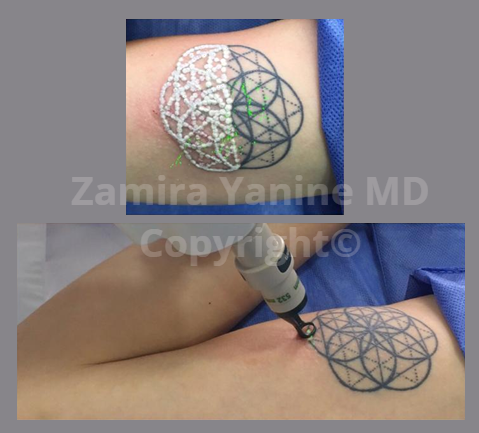
The Q-switched laser has a photoacoustic effect, meaning that each light emission lasts only 5-60 nanoseconds. Tattoo ink and the skin's natural pigmentation (melanin) rapidly absorb these short, high-energy pulses. This photoacoustic effect allows the tattoo pigment to be broken down into millions of particles, which are then eliminated by the body's macrophages.
- Will the tattoo disappear completely?
Most tattoos don't disappear completely. For the most part, the tattoo will fade to almost imperceptible remnants of color.
- What will I feel during the treatment?
The treatment is completely tolerable and may require the use of topical or injectable local anesthetic to minimize discomfort from the laser pulse. Cold (ice) may also be applied before each pulse. During the treatment, you will experience a warm, burning sensation in the treated area. Immediately after each laser pulse, the pigment will lighten, but this will disappear spontaneously. The treated area will then have a dark red color, which will later turn purplish.
- How will my skin look and feel after the treatment?
After treatment, you will experience redness, swelling, burning, and possibly some minor pinpoint bleeding in the treated area of skin. These changes will gradually improve over 3 to 24 hours. A scab will begin to form on the second or third day and will fall off on its own around the tenth day.
- How many sessions are needed to remove the tattoo?
The number of sessions required varies depending on the type of tattoo (professional or amateur), its size, the type of ink used, and each client's individual response. Generally, a professional tattoo requires more sessions than an amateur or "homemade" one. On average, a session is performed every 6 to 8 weeks.
- What precautions should I take before treatment?
➤ Prepare your skin with moisturizer, sunscreen, and a skin-lightening cream for at least 15 days to reduce the risk of hyperpigmentation. ➤ Avoid sun exposure for 15 days before treatment. ➤ Take prophylactic antiviral treatment if you have an active herpes simplex ("cold sores") or herpes zoster ("shingles") infection. ➤ Avoid smoking.
- What care should I take after the treatment?
➤ Apply Fucidin ointment to the treated area 3 times a day for the first 3 days to prevent infection and promote proper healing. ➤ Keep the treated area covered for the first 10 days, changing the gauze daily after bathing and applying the recommended ointment. ➤ After bathing, pat the treated area dry gently, without rubbing. Ideally, use cool or lukewarm water. ➤ It is important to avoid removing scabs to promote proper healing and prevent infection. ➤ Once the scabs fall off, apply sunscreen every 3 hours if the tattoo is in an area exposed to sunlight. ➤ Do not use tanning beds or apply self-tanner to the treated area. ➤ Do not go to saunas, Turkish baths, or swimming pools for the first 15 days. ➤ You can resume your normal daily activities.
- What are the contraindications of the treatment?
➤Allergy to tattoo ink ➤Pregnancy or breastfeeding ➤Active infection (e.g., herpes simplex) ➤Use of isotretinoin in the last 6 months ➤Exposure to radiotherapy in the last 6 months ➤History of abnormal hypertrophic or keloid scarring ➤Patients with autoimmune diseases and immunosuppressed patients ➤History of treatment with gold salts
Slide title
Escriba el subtítulo aquíButton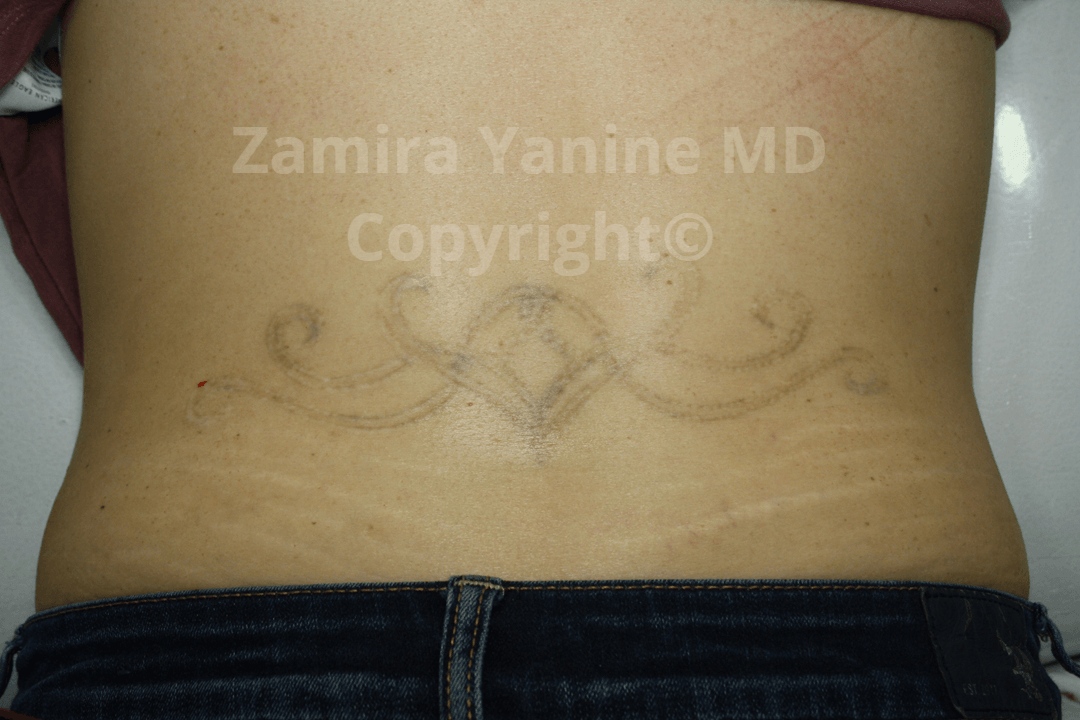
Slide title
Escriba el subtítulo aquíButton
Contact us
Thank you for contacting us.
We will respond as soon as possible.
An error occurred while sending your message.
Try again later.